
- Published:
- affiliate marketing for mobile apps, creator marketing, in-app-experiences, mobile app personalization, programmatic-affiliate-marketing
Affiliate marketing usually ends at attribution.
A creator shares a link. A user installs the app. The platform records who drove the install and, later, any revenue that follows.
That measurement matters—but it leaves the most valuable moment untouched: what the referred user experiences after opening the app.
Programmatic Affiliate Marketing changes that. It lets your app use affiliate context as a product input, so the experience can reflect the creator, partner, campaign, or recommendation that brought the user there.
This Product Update makes that context configurable at two levels: for an entire campaign and for an individual affiliate within that campaign.
Here is what that looks like in practice.
What is Programmatic Affiliate Marketing?
Programmatic Affiliate Marketing is the ability to use affiliate attribution inside the mobile app experience—not only in reports. It gives an iOS or Android app affiliate and campaign context it can use for personalized onboarding, deep links, content, paywalls, and approved offers.
For a broader introduction to the model, read Introducing Programmatic Affiliate Marketing. This Product Update focuses on the new configuration workflow and a practical example.
From creator recommendation to app experience
In the video, Ashley promotes Compass Maps, our example mobile app, to her audience.
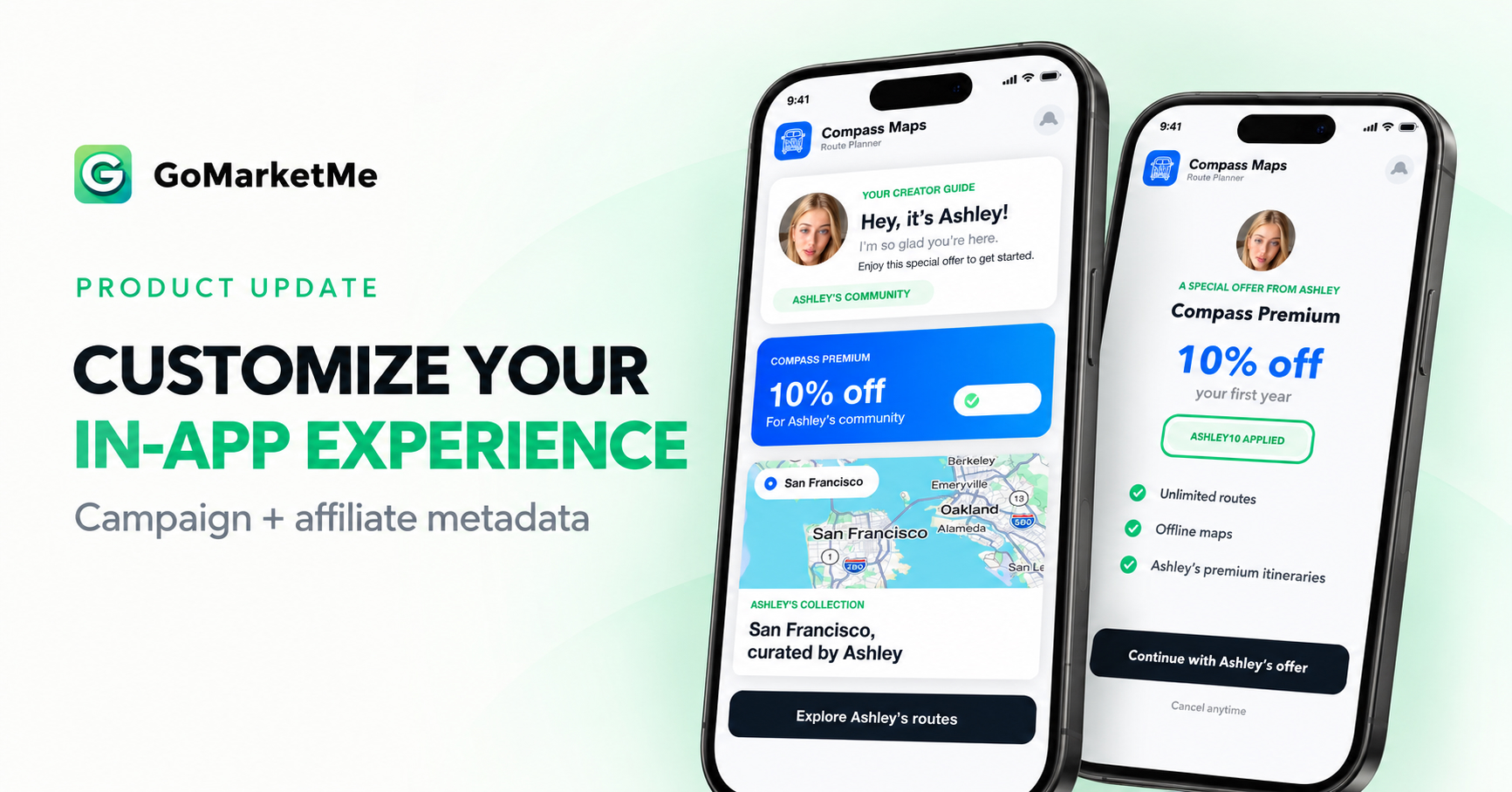
Her recommendation does more than generate a measurable install. When a new user follows Ashley’s affiliate link, GoMarketMe makes the referral context available to the app. Compass Maps can then decide how to use that context in its own product experience.
In this example, the app can show:
- a welcome from Ashley
- a 10% offer for her audience
- San Francisco trips connected to the content she promoted
- a creator-specific paywall with the relevant offer already applied
The app is still in control of the experience. GoMarketMe supplies the affiliate and campaign context; your product decides what to display and how to respond.
That distinction is important. Programmatic Affiliate Marketing is not a page builder or a paywall tool. It is the layer that helps your app recognize the referral and pass useful context into your onboarding, CRM, analytics, paywall platform, or custom in-app logic.
Product Update: Configure metadata at two levels
GoMarketMe now gives your team two places to define the metadata your app receives. Campaign-level metadata provides the shared context for a campaign. Affiliate-level metadata lets you attach creator-specific context to one affiliate within that campaign.
The two payloads are returned separately by GoMarketMe SDK v6+, so your app remains in control of how it uses or combines them.
1. Campaign-level metadata
Set campaign-level metadata from the campaign configuration page under Advanced.
This metadata is included when a referred user is attributed to the campaign, regardless of which affiliate referred them. It is useful for campaign-wide behavior such as selecting a general paywall variant or sending every referred user to the same starting destination.
For example:
{
  "paywall_variant": "creator-offer",
  "deep_link": {
    "page_id": "creator-home"
  }
}
In the SDK response, campaign-level metadata is available through affiliateMarketingData.campaign.metadata.
2. Affiliate-level metadata for a campaign
Set affiliate-level metadata from the campaign configuration page by opening Affiliates, choosing Edit for an affiliate, and expanding Advanced.
This payload belongs to that affiliate within that specific campaign. It can carry the creator-specific welcome, profile image, destination, or platform-specific offer configuration your app needs.
For example:
{
  "profile_image_url": "https://example.com/ashley.jpg",
  "welcome_title": "Hey, it’s Ashley!",
  "welcome_description": "I’m so glad you’re here. Enjoy this special offer to get started.",
  "deep_link": {
    "page_id": "ashley-creator-home"
  },
  "offers": {
    "ios": {
      "com.example.app.premium.monthly": {
        "code": "ASHLEY10MONTHLY"
      },
      "com.example.app.premium.yearly": {
        "code": "ASHLEY10YEARLY"
      }
    },
    "android": {
      "com.example.app.premium": {
        "base_plan_id": "monthly",
        "offer_id": "ashley-10"
      }
    }
  }
}
In the SDK response, affiliate-level metadata for the campaign is available through affiliateMarketingData.affiliateCampaign.metadata.
Only your team can edit these payloads. As with any client-readable configuration, do not include secrets or private customer data.
What happens when a user taps an affiliate link?
The flow is simple:
- A creator promotes your app. Each affiliate can share a unique GoMarketMe link, QR code, or referral code.
- A user follows the recommendation. They tap the creator’s link and continue to your app.
- GoMarketMe identifies the referral context. Your app can access the affiliate and campaign information available through the GoMarketMe SDK.
- Your app responds. You can use that context to adapt onboarding, content, engagement, offers, or monetization.
In the Compass Maps example, Ashley’s referral code is applied automatically when the user opens the app through her link. The first session can then continue the story that began in Ashley’s social post instead of dropping the user into a generic experience.
That continuity is the real opportunity.
Why the first session should reflect the recommendation
Creators rarely promote an app in the abstract. They promote a specific outcome.
A fitness creator may share a training plan. A travel creator may recommend a city guide. A finance educator may demonstrate a budgeting workflow. A productivity creator may highlight one feature that solves a particular problem.
But after install, most referred users see the same generic onboarding as everyone else.
The context disappears precisely when it could be most useful.
With Programmatic Affiliate Marketing, mobile teams can connect acquisition and product more intelligently. A referred user can arrive at the feature, content, community, or offer that matches the recommendation they just saw.
That can reduce friction between interest and value. It can also give creators more confidence that the app experience supports the promise they made to their audience.
One signal, many possible experiences
Affiliate context can support far more than a personalized welcome. Depending on your app and your implementation, you could use it to:
- open the content or feature a creator promoted
- tailor onboarding to a specific audience or use case
- let a user follow the creator who referred them
- display creator-specific collections, plans, or resources
- pass affiliate context into RevenueCat, Superwall, or your own paywall logic
- trigger approved offers for eligible referred users
- segment lifecycle messaging and analytics by partner or campaign
The right experience depends on your product. A social app may connect a new user directly with a creator or community. A fitness app may open a featured program. A shopping app may show a curated collection. A subscription app may adapt its paywall message to match the recommendation.
The common idea is simple: attribution should not sit idle in a dashboard. It should be available at the moment your app can act on it.
Built for mobile apps
Programmatic Affiliate Marketing is designed for the realities of iOS and Android apps.
Mobile journeys cross creator content, affiliate links, app stores, installs, first opens, subscriptions, and in-app purchases. GoMarketMe connects the referral to the app experience so mobile teams can measure the relationship and make it useful inside the product.
That is the shift from affiliate tracking to affiliate-aware product design.
Not just knowing who sent the user.
Knowing enough to give that user a better next step.
Programmatic Affiliate Marketing FAQ
What is campaign-level metadata?
Campaign-level metadata is a JSON payload shared across a GoMarketMe campaign. It is returned for users attributed to that campaign, regardless of which affiliate referred them, and is available through affiliateMarketingData.campaign.metadata.
What is affiliate-level metadata?
Affiliate-level metadata is a JSON payload attached to one affiliate within one campaign. It can contain creator-specific onboarding, deep-link, profile, paywall, or offer configuration and is available through affiliateMarketingData.affiliateCampaign.metadata.
Does Programmatic Affiliate Marketing replace a paywall tool?
No. GoMarketMe provides the affiliate and campaign context. Your app can pass that context into RevenueCat, Superwall, or its own paywall and product logic.
What will PAM unlock in your app?
The Compass Maps experience in the video is one example. The more interesting question is what creator or partner context could unlock in your own product.
Could a creator referral make onboarding more relevant? Bring a user directly to the feature they saw? Connect them with a community? Surface an eligible offer? Make the first session feel like a continuation of the recommendation rather than a restart?
That is what Programmatic Affiliate Marketing makes possible.
Learn more about Programmatic Affiliate Marketing or get started with GoMarketMe.