
- Published:
In mobile, growth is rarely linear.
Traffic does not always ramp gradually. It can arrive in bursts: an affiliate campaign starts converting, a creator drives installs, a press mention lands, or a partner sends a sudden wave of users. In a short span of time, install volume rises, attribution events spike, and purchase activity accelerates.
That is why scale cannot be treated as a later-stage concern.
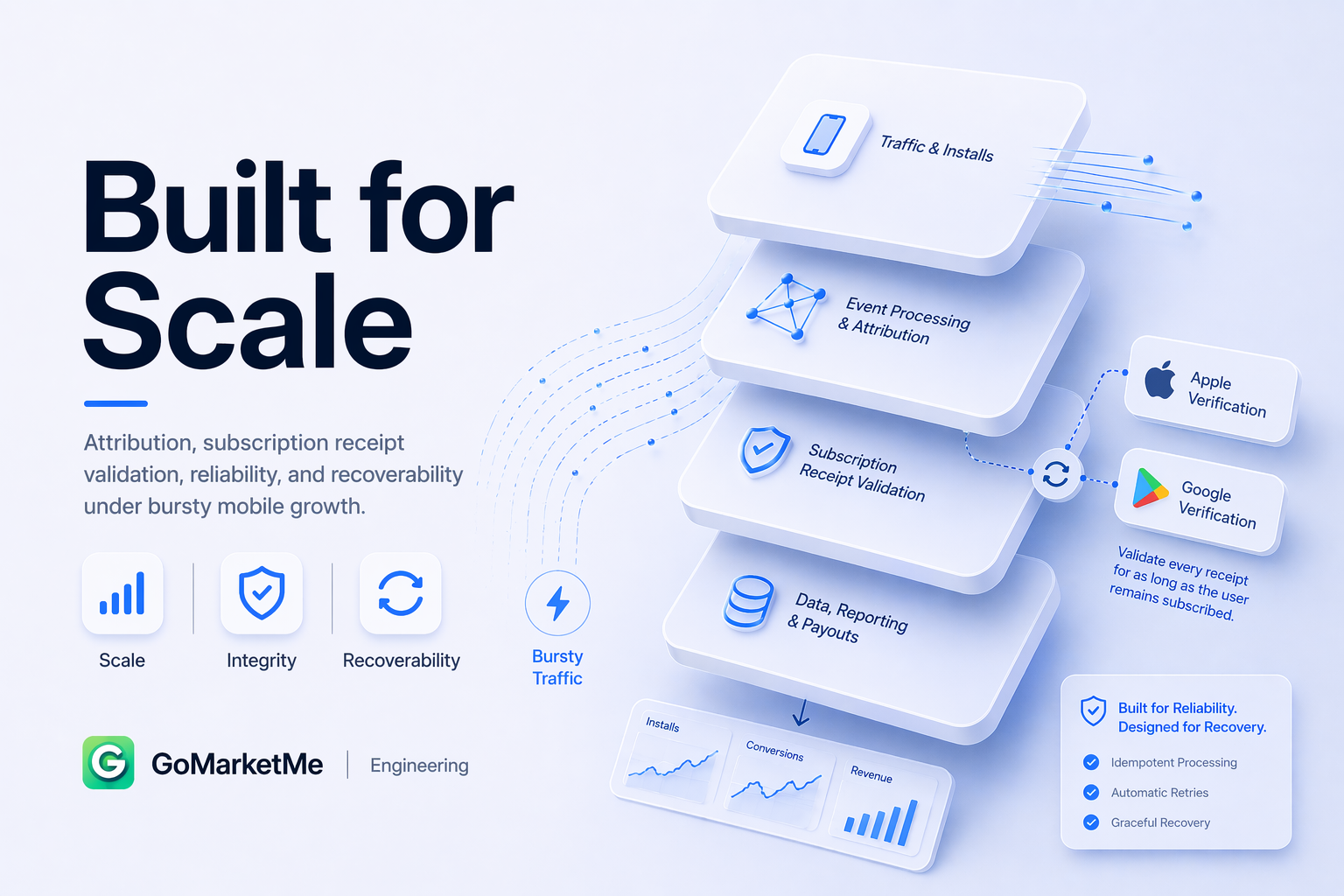
At GoMarketMe, scale was part of the design from day 0. The platform had to support bursty traffic patterns, preserve attribution integrity under load, and remain recoverable when systems are under pressure. In mobile app affiliate marketing, those are not edge-case requirements. They are baseline requirements.
Why this had to be designed in from the start
A common early-stage mistake is assuming scale can be addressed later.
Our founder learned the opposite through years in Ad Tech and app development, where distributed systems are expected to handle volatile traffic, high event throughput, and strict reliability expectations. That experience made one thing clear early: if the product is intended to support growth, the architecture has to assume non-linear demand from the beginning.
That assumption shaped GoMarketMe.
Instead of designing around average load, we designed around variability. That means planning for bursts from affiliates, influencers, strategic partners, or media exposure, while ensuring the platform continues to behave predictably when event volume changes quickly.
Mobile growth creates bursty infrastructure patterns
Mobile app growth has a very specific shape.
A user can tap an affiliate link, install immediately, open the app, convert, and subscribe within minutes. Multiply that across a campaign that starts gaining momentum, and the backend must absorb a sudden increase in event volume across attribution, purchase processing, reporting, and downstream logic.
For a platform like GoMarketMe, that means several things have to hold up simultaneously:
- attribution must remain accurate
- event processing must remain deterministic
- reporting must remain consistent
- the system must remain resilient under uneven load
It is not enough for the platform to work well in steady-state conditions. It has to work when demand compresses into short windows.
Subscription infrastructure is where scale gets more demanding
One-time purchases are only part of the problem.
Subscriptions introduce ongoing verification requirements that materially raise the bar for infrastructure. For subscription-based apps, authenticity must be validated with Apple or Google for every receipt, and not just at initial conversion. That validation must continue for as long as the user remains subscribed.
This changes the scaling model.
The system is not only handling new acquisition events and initial purchase signals. It is also responsible for recurring receipt validation over time, across an expanding subscription base. As volume grows, verification workload grows with it.
That means scale is not just about handling bursts of front-end demand. It is also about sustaining long-lived correctness in the background.
For mobile subscription businesses, that distinction matters.
Scale without correctness is not useful
In attribution infrastructure, throughput alone is not the goal.
The real requirement is correctness under load.
If an affiliate drives a surge in installs, attribution logic still has to resolve accurately. If purchase events spike, processing still has to remain consistent. If subscriptions accumulate over time, validation still has to happen reliably across the lifetime of those subscriptions.
This is where many systems become fragile. They may tolerate higher volume in theory, but begin to degrade where it matters most: timing, consistency, recoverability, or trust.
For GoMarketMe, the standard was never just “can it stay up?” The standard was “can it remain dependable when volume, timing, and verification demands all increase together?”
Recoverability is part of the architecture
Any serious system has to assume imperfect conditions.
Retries, transient failures, partial outages, upstream dependency issues, delayed events, and unexpected bursts are all part of operating real infrastructure. The question is not whether they can happen. The question is whether the system is designed to recover cleanly when they do.
That has been part of the thinking from the start.
GoMarketMe was built not only to scale, but to recover at any time. That matters because a growth platform cannot depend on ideal conditions. It has to be engineered for resilience, replayability where needed, and operational confidence when the environment becomes noisy.
Recoverability is not a secondary feature. It is one of the properties that makes scale usable.
Why this matters in mobile affiliate marketing
Affiliate marketing for apps is not the same as affiliate marketing for the web.
Mobile introduces different attribution constraints, different conversion flows, and different revenue mechanics, especially when in-app purchases and subscriptions are involved across iOS and Android. The infrastructure behind it has to account for that complexity without becoming brittle as volume grows.
That is why scale is not just an engineering concern. It is a product concern and a business concern.
If attribution becomes inconsistent during growth, trust drops. If receipt validation is not handled reliably, revenue intelligence degrades. If systems cannot recover gracefully, operational risk rises precisely when momentum should be turning into growth.
Built for growth, not just average conditions
Many systems perform adequately under normal load.
The real test is what happens when traffic is uneven, event volume compresses, and verification workload compounds over time. That is what real growth looks like in mobile.
A strong affiliate campaign, a breakout creator mention, or coverage from a publication like TechCrunch can generate that kind of pressure quickly. Those are not anomalies. They are the conditions a growth platform should expect.
GoMarketMe was built with that expectation in mind.
Final thoughts
Built for Scale from Day 0 is not just a positioning line. It reflects a technical requirement.
GoMarketMe was designed for bursty mobile growth, attribution correctness under load, ongoing subscription receipt validation, and graceful recovery when systems are stressed. Our founder’s background in Ad Tech and app development helped shape that view early: if you wait until growth arrives to think seriously about scale, you are already late.
In mobile, success often shows up as a spike.
The infrastructure behind it should already be ready.
Get Started with GoMarketMe:
https://gomarketme.co
Or book a call with us:
https://calendly.com/support-a4ap/onboarding